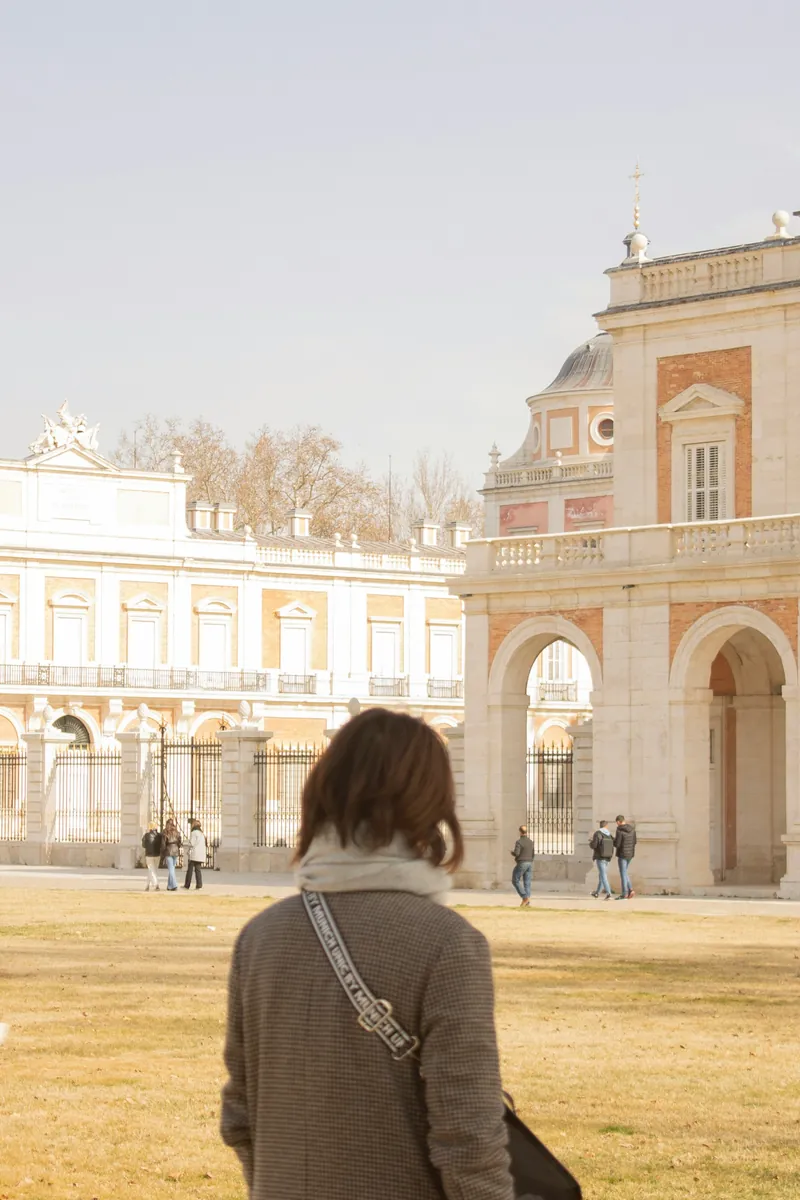
For more than four centuries this was where the Spanish court fled the heat of Madrid. Set where the Tagus and Jarama rivers meet, the Royal Palace of Aranjuez was conceived as a spring residence — a place of fountains, tree-lined avenues and cool riverside walks designed to rival Versailles. Begun in earnest under Philip II in 1561 and reshaped by the Bourbon kings into the rococo masterpiece you see today, it remains one of the most graceful royal sites in Spain.
Inside, a sequence of state rooms unfolds in gilded, jewel-box intimacy: the Throne Room where Charles IV abdicated in 1808, the dazzling Porcelain Room lined floor-to-ceiling in glazed ceramic, and the Arab Cabinet inspired by the Alhambra. Every salon layers silk, mirror and chandelier into the unmistakable taste of the 18th-century court — a more delicate, domestic counterpoint to the grand palaces of the capital.
Beyond the walls lie the gardens that earned Aranjuez its fame. The Island Garden, cradled in a loop of the river, hides shaded fountains and statuary among ancient plane trees, while the formal Parterre stretches in clipped symmetry before the façade. Further out sit the Prince's Garden and the neoclassical Casa del Labrador, a lavish pleasure pavilion built for Charles IV. The whole cultural landscape was inscribed by UNESCO in 2001 for the way it weaves nature, water and royal design into a single composition.
We are an independent concierge ticket service. We secure your timed ticket, confirm it instantly, and stay on hand if your plans change — so you arrive at your selected entry time, walk past the box-office queue, and step straight into the palace.